The Challenge of Designing Next-Gen Antennas
As the world races toward 6G wireless networks, engineers face a daunting challenge: designing millimeter-wave antennas that are compact, efficient, and manufacturable at scale. Traditional optimization methods require thousands of electromagnetic simulations, each taking hours to complete. But what if artificial intelligence could learn to design better antennas in a fraction of the time?
I built this system with collaborators at Bapatla Engineering College, Lovely Professional University, and CoreIOT Technologies, combining reinforcement learning with uncertainty-aware modeling. It achieved a 72% reduction in simulation time while delivering better performance than conventional methods.
Why Traditional Methods Fall Short
Conventional electromagnetic optimization techniques like genetic algorithms (GA) and particle swarm optimization (PSO) have served engineers well for decades. However, they come with significant limitations:
- Computational Cost: These methods typically require 1,200-1,500 full-wave simulations, each consuming substantial computing resources
- Lack of Uncertainty Awareness: Most approaches provide deterministic predictions without indicating confidence levels, potentially leading to unreliable designs
- Manufacturability Gaps: Optimization algorithms often produce geometries that look good on paper but can't actually be fabricated due to physical constraints
- Poor Scalability: As design complexity increases, traditional methods struggle to explore high-dimensional parameter spaces efficiently
For 6G millimeter-wave systems operating at 28 GHz and beyond, these limitations become critical bottlenecks in the development pipeline.
Enter Uncertainty-Aware Reinforcement Learning
The framework combines three key innovations:
1. Blended Surrogate Models
Instead of relying on expensive electromagnetic simulations for every design iteration, the system uses a hybrid ensemble of machine learning models:
- LightGBM (gradient boosting)
- Multilayer Perceptron (neural network)
- Ridge Regression with cross-validation
This ensemble doesn't just predict antenna performance—it also quantifies uncertainty in its predictions, allowing the system to know when it's operating in reliable versus risky design regions.
2. Soft Actor-Critic Reinforcement Learning
The team employed SAC, a state-of-the-art RL algorithm that excels in continuous control tasks. The AI agent learns to adjust antenna geometry parameters (patch width, length, feed dimensions, etc.) to maximize performance while respecting physical constraints.
3. Fabrication-Aware Optimization
Unlike previous approaches, this framework incorporates real-world manufacturing constraints directly into the learning process. The reward function penalizes designs that violate PCB fabrication rules, ensuring all generated antennas can actually be built on standard FR-4 substrates.
How the System Works
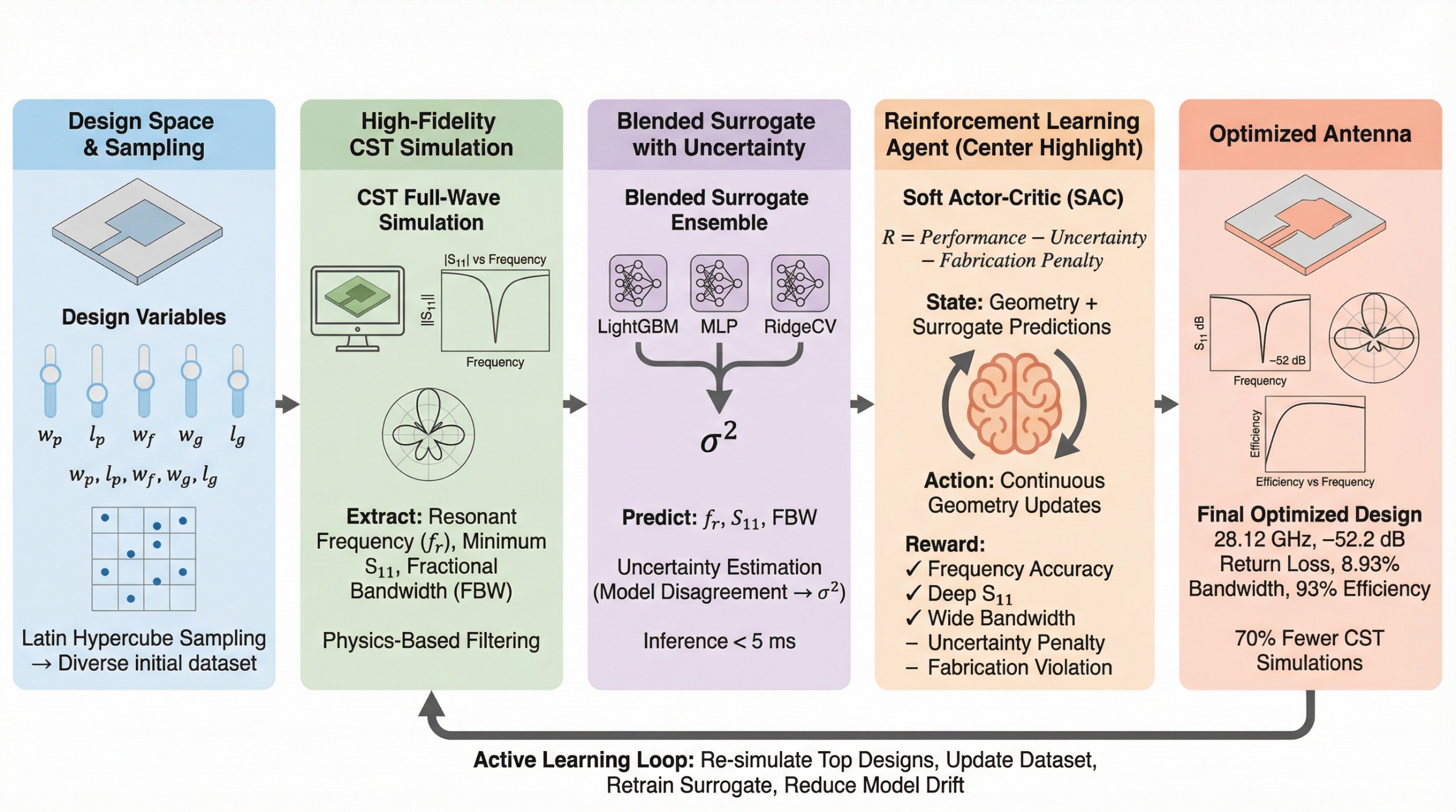
The optimization pipeline follows five key steps:
Latin Hypercube Sampling generates diverse initial antenna geometries within physically valid bounds (e.g., patch width: 2.2-3.6 mm, feed width: 0.30-0.55 mm).
Each geometry is simulated in CST Studio Suite across 24-34 GHz to extract key metrics: resonant frequency, return loss (S11), and fractional bandwidth.
The blended ensemble learns to predict electromagnetic responses with uncertainty estimates. The model achieves impressive accuracy: 0.14 GHz error in resonant frequency, 0.36 dB in return loss.
The SAC agent explores the design space using the fast surrogate model (inference time: <5 ms vs. hours for full simulation). The reward function balances multiple objectives:
- Resonant frequency accuracy (45% weight)
- Deep return loss (35% weight)
- Wide bandwidth (20% weight)
- Uncertainty penalty (applied at 0.10 scale)
- Fabrication constraint penalty (applied at 0.05 scale)
Top-performing designs are re-simulated in CST to verify performance. These validated results are fed back to retrain the surrogate, improving accuracy in promising design regions.
Impressive Performance Gains
The proposed system delivered outstanding results when applied to a 28 GHz FR-4 microstrip patch antenna:
- Return Loss: -52.2 dB (indicating excellent impedance matching)
- Fractional Bandwidth: 8.93% (superior to the 7.1-7.4% achieved by GA/PSO)
- Resonant Frequency: 28.12 GHz (precisely on target)
- Radiation Efficiency: >80.6% across the operating band
- Realized Gain: 5.27 dBi peak at 28 GHz
Efficiency Improvements
- 72% Reduction in Simulations: Only 420 CST evaluations vs. ~1,500 CST Studio calls for traditional methods
- Faster Convergence: Stable learning with progressively increasing episode lengths (32→64→128 steps)
- Better Accuracy: Surrogate ensemble outperformed individual models across all metrics
These results demonstrate that uncertainty-aware RL can achieve both superior performance and dramatic efficiency gains—a true win-win for antenna engineers.
Key Technical Innovations
Several clever design choices make this framework particularly effective:
Model Disagreement as Uncertainty
By training multiple diverse models and measuring their variance, the system obtains a practical uncertainty estimate without expensive probabilistic methods like Gaussian Processes. When models disagree significantly, the agent knows to explore cautiously.
Progressive Episode Lengths
Starting with short episodes (32 steps) and gradually increasing to 128 steps helps the agent learn stable policies before tackling longer optimization horizons. This curriculum-style approach improves convergence.
Normalized Observations and Rewards
Standardizing inputs and clipping rewards to ±10 prevents numerical instabilities that often plague RL training, especially important for continuous control in engineering applications.
Physics-Based Validation
Before any geometry enters the dataset, it passes physics checks (e.g., ground plane must be larger than patch, all dimensions positive). This prevents the surrogate from learning unrealistic relationships.
Impact on 6G Development
This research has significant implications for next-generation wireless systems:
- Accelerated Design Cycles: What previously took weeks of iterative simulation can now be accomplished in days, enabling faster prototyping and testing of novel antenna architectures
- Cost Reduction: By dramatically reducing computational requirements, the framework makes advanced optimization accessible to smaller research teams and companies without massive computing clusters
- Reliability Guarantees: Uncertainty quantification helps engineers understand where designs are trustworthy versus where additional validation is needed—crucial for safety-critical applications
- Manufacturability by Design: Integrating fabrication constraints from the start ensures smooth transitions from simulation to production, reducing costly redesign cycles
- Scalability Potential: The methodology can extend to multi-band antennas, phased arrays, reconfigurable intelligent surfaces (RIS), and other complex electromagnetic structures—addressing diverse 6G use cases
How It Stacks Up Against Alternatives
I compared the approach against several baseline methods:
| Method | Simulations Required | Bandwidth Achieved | Improvement |
|---|---|---|---|
| Uncertainty-Aware SAC | 420 | 8.93% | — (reference) |
| Genetic Algorithm (GA) | 1,500 | 7.1% | 72% fewer sims, 26% better BW |
| Particle Swarm (PSO) | 1,200 | 7.4% | 65% fewer sims, 21% better BW |
| Deep Q-Network (DQN) | 950 | 8.1% | 56% fewer sims, 10% better BW |
| Proximal Policy Opt. (PPO) | 680 | 8.6% | 38% fewer sims, 4% better BW |
The uncertainty-aware SAC approach consistently outperformed alternatives across both efficiency and performance metrics.
Future Research Directions
Several extensions remain open:
- Multi-Band and Wideband Extensions: Adapting the framework to optimize antennas covering multiple frequency bands simultaneously, critical for versatile 6G devices
- Phased Arrays and RIS: Applying the methodology to more complex structures like antenna arrays and reconfigurable intelligent surfaces, which have hundreds of optimization parameters
- Expanded Objectives: Incorporating additional metrics like radiation pattern shape, polarization purity, and specific absorption rate (SAR) into the reward function
- Hardware-in-the-Loop: Combining simulations with real-time measurements from fabricated prototypes to account for manufacturing variations and material tolerances
- Generative Design Initialization: Using generative models (VAEs, GANs, or diffusion models) to propose promising initial geometries, potentially reducing the required simulations even further
- Transfer Learning: Leveraging knowledge from optimizing one antenna type to accelerate design of related structures—essentially creating an AI antenna designer with accumulated expertise
Practical Takeaways for Engineers
For RF engineers and researchers looking to apply these methods:
- Start Simple: Begin with well-understood antenna types and gradually increase complexity. The framework's modular design supports this incremental approach
- Invest in Surrogate Quality: The blended ensemble approach significantly outperforms single models. Spending extra effort on surrogate training pays dividends in optimization quality
- Embrace Uncertainty: Uncertainty estimates aren't just academic—they provide actionable guidance on where to invest validation resources
- Constraint Engineering Matters: Carefully encoding fabrication rules as soft penalties (rather than hard constraints) allows the agent to explore the boundary of feasible designs
- Active Learning is Key: Periodically validating top designs and retraining surrogates prevents model drift and ensures reliable optimization throughout the process
- Computational Accessibility: The framework ran on a modest CPU-only workstation (Intel Core i5), demonstrating that advanced ML-driven optimization doesn't require expensive GPU clusters
A New Paradigm for Electromagnetic Design
This research represents more than an incremental improvement—it demonstrates a fundamental shift in how we approach electromagnetic optimization. By combining uncertainty-aware machine learning with reinforcement learning and fabrication constraints, the team has created a framework that is simultaneously more efficient, more reliable, and more practical than traditional methods.
As 6G networks demand increasingly sophisticated antenna designs operating at higher frequencies with tighter tolerances, automated, intelligent optimization will transition from a nice-to-have to an absolute necessity. This work provides a roadmap for achieving that vision.
The 72% reduction in simulation requirements isn't just about saving time—it democratizes advanced antenna design, making cutting-edge optimization techniques accessible to a broader community of researchers and engineers. Combined with the superior 8.93% bandwidth and -52.2 dB return loss performance, this framework sets a new benchmark for what's possible in AI-driven electromagnetic design.
Interested in AI-driven electromagnetic optimization and 6G wireless systems? Let's connect!
← Back to Blog